Scholarship
Four questions that have guided my research
My research has focused on understanding the role of self-worth in people's lives—how it shapes motivation, relationships, and well-being, and how shifting what motivates us can lead to healthier, more connected lives. I’ve organized this page around four questions that have guided my research. For a complete list of publications and professional activities, see my CV (PDF), or see my Google Scholar profile.
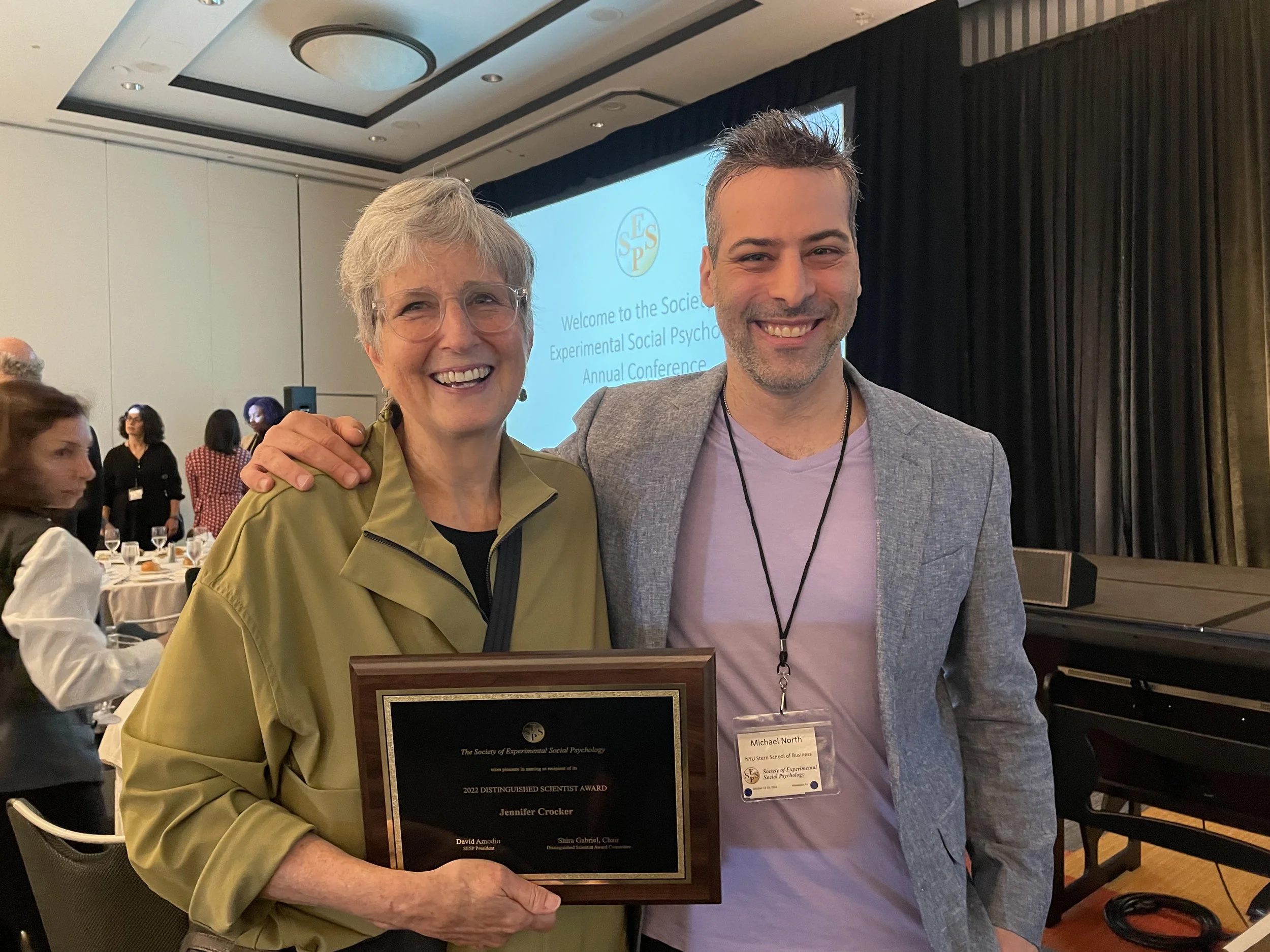
Congratulated by former student Michael North after receiving the 2022 Distinguished Scientist Award from the Society for Experimental Social Psychology.
Social Stigma and Self-Esteem
When do prejudice and discrimination lead to lower self-esteem?
For many years, psychologists assumed that people who are targets of prejudice and discrimination would have low self-esteem. In a widely cited theoretical paper, Brenda Major and I challenged that assumption. We found that although some stigmatized individuals internalize negative views of their group, many do not. We argued that social stigma can sometimes protect self-esteem—when people attribute negative experiences to prejudice rather than personal inadequacy, compare themselves with other members of their group, or place less importance on domains in which they are devalued. Subsequent research provided strong support for our perspective.
Social stigma and self-esteem: The self-protective properties of stigma. Psychological Review (1989)
Social stigma: The affective consequences of attributional ambiguity. Journal of Personality and Social Psychology (1991)
The stigma of overweight: The affective consequences of attributional ambiguity. Journal of Personality and Social Psychology (1993)
Contingencies of Self-Worth
What do people base their self-esteem on, and why does it matter?
I called the domains on which people base their self-worth contingencies of self-worth. They represent what people believe they need to be or do to have worth and value as a person. Our research showed that when self-worth is highly contingent on success in these domains, it becomes fragile, leading people to pursue self-esteem in ways that often undermine learning, relationships, and well-being.
Throughout this website, I use self-esteem and self-worth interchangeably.
Contingencies of self-worth. Psychological Review. (2001)
The costly pursuit of self-esteem. Psychological Bulletin. (2004)
Hopes dashed and dreams fulfilled: Contingencies of self-worth in the graduate school admissions process. Personality and Social Psychology Bulletin (2002)
Egosystem and Ecosystem Motivation
What difference does it make when our goals shift from self-protection to contribution?
We often want to protect, prove, or enhance our self-worth. I called this egosystem motivation because people focus on themselves; other people become a means or an obstacle to getting what they want. By contrast, ecosystem motivation arises when people see themselves as part of a larger system in which people’s well-being is interconnected. They focus on contributing, learning, and supporting the well-being of others while caring for themselves.
Our research showed that these two motivational systems, characterized by self-image goals and compassionate goals, have very different consequences. When people are guided by ecosystem motivation, their well-being improves, their relationships become supportive, and other people respond constructively. Rather than putting their own needs aside, they recognize that their own flourishing depends on the flourishing of the larger system.
Creating and undermining social support in communal relationships: The role of compassionate and self-image goals. Journal of Personality and Social Psychology (2008).
Interpersonal goals and change in anxiety and dysphoria: Effects of compassionate and self-image goals. Journal of Personality and Social Psychology (2010).
Social motivation: Costs and benefits of selfishness and otherishness. Annual Review of Psychology. (2017).
Building Good Relationships
Can we create healthier, more supportive relationships?
High-quality close relationships are essential to health and well-being. Our research asked how people can help create the kinds of relationships they want to have. We found that people with ecosystem motivation are more likely to foster trust, responsiveness, and mutual support, creating relationships that benefit both partners.
Creating good relationships: Responsiveness, relationship quality, and interpersonal goals. Journal of Personality and Social Psychology (2011).
Romantic relationships in the ecosystem: Compassionate goals, nonzero-sum beliefs, and change in relationship quality. Journal of Personality and Social Psychology (2016).
Predicting change in relationship insecurity: The roles of compassionate and self‐image goals. Personal Relationships. (2013).